
Your Customer Has a New Shopping Buddy. And It’s Not You.

Shopping used to be a relatively private affair.
You walked into a store, stared at two nearly identical products for an unreasonable amount of time, picked one based on a combination of price, packaging, and vibes, and hoped for the best.
Maybe you asked a friend. Maybe you read a review. Maybe you called your mother, who somehow had a strong opinion despite never having purchased the product in question.
Now, there’s someone else coming along for the trip.
AI is quietly becoming a new decision layer in shopping, helping consumers compare options, understand value, stay within budget, and answer one of the most important questions in retail:
Am I making a smart choice here?
And for brands, that could fundamentally change what it means to make the consideration set.
Value Got Complicated
Consumers still care about price. Quite a lot, actually.
But price and value are not interchangeable.
Research from BCG reported by Retail Brew found that 67% of consumers would pass on something they could afford if they didn’t believe it offered strong value. And when consumers determine what constitutes value, quality accounts for 35% of satisfaction, compared with 27% for price and promotions.
In other words, consumers aren't necessarily asking, “What's cheapest?”
They're asking, “What's worth it?”
That's a much harder question to answer when you're staring at 37 varieties of the same basic product, all promising to be premium, natural, authentic, improved, artisanal, or somehow “inspired.”
Which brings us to our new shopping buddy.
The Second Opinion Has Entered the Chat
AI's appeal in shopping may have less to do with futuristic technology than with a very old-fashioned human desire:
We don't want to make a bad decision.
Already, 36% of Americans say they've tried or currently use AI shopping tools. Usage is even higher among younger consumers, reaching 47% of Gen Z and 50% of Millennials.
But here's the number brands should really notice: 51% of consumers would rather use AI shopping tools to reduce the risk of making a bad purchase. Among Gen Z and Millennials, that rises to 62%.
That's an important distinction.
People aren't necessarily handing over their credit cards and saying, “You handle it, robot.”
They're asking for reassurance.
Compare these two products. Tell me which is healthier. Is the bigger package actually cheaper per serving? Which one has better reviews? Am I paying $4 more because this olive oil has a prettier bottle?
AI is becoming the friend who says, “Actually, I checked.”
The Shortlist Comes Before the Shelf
This introduces an interesting wrinkle into the traditional consumer journey.
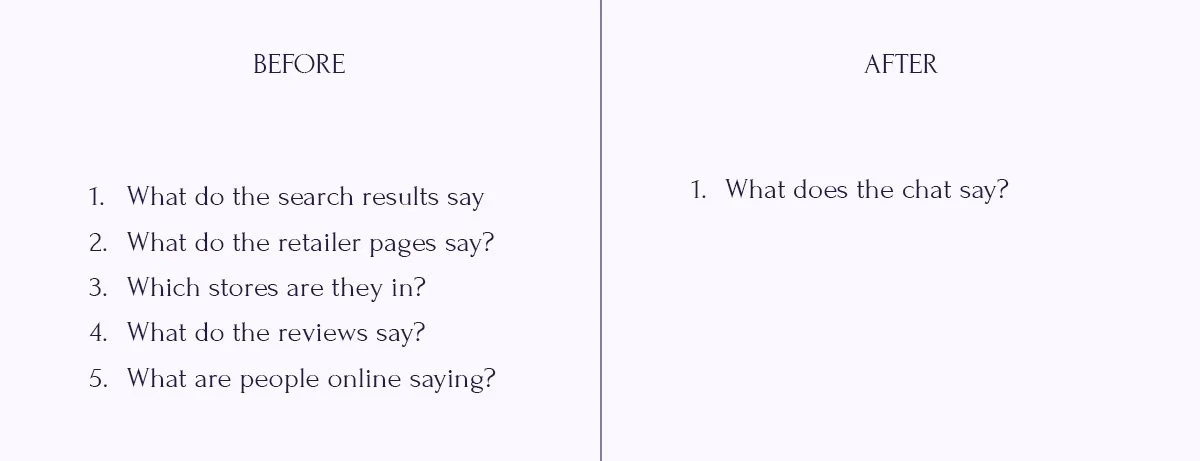
For years, brands have fought to win search results, retailer pages, shelf placement, reviews, social feeds, and every other place where consumers discover products.
Those battlegrounds aren't disappearing.
But now the shopper can arrive there with a shortlist already forming.
Imagine someone asking:
What's the best high-protein cereal under $6?
Which sunscreen is good for sensitive skin without costing $40?
What's a decent coffee that doesn't taste like something served in a courthouse waiting room?
AI can evaluate the options and narrow dozens of products into a handful.
The consumer may still validate those recommendations through price, ratings, package size, retailer search, or a product detail page. But the first cut has already happened.
Brands therefore have a new question to consider.
It's no longer enough to ask:
Are we searchable?
Increasingly, brands need to ask:
Are we recommendable?
Welcome to Aisle Seven, Your Algorithm Is Waiting
This isn't only happening from the couch.
39% of consumers say they're already using AI in stores for real-time help. That rises to 52% of Gen Z and 55% of Millennials.
Grocery may offer one of the most interesting previews of what's coming. 15% of U.S. consumers have used tools such as ChatGPT for grocery shopping in the past year, with shopping lists and price comparisons among the most common uses.
And grocery is almost perfectly designed for this kind of assistance.
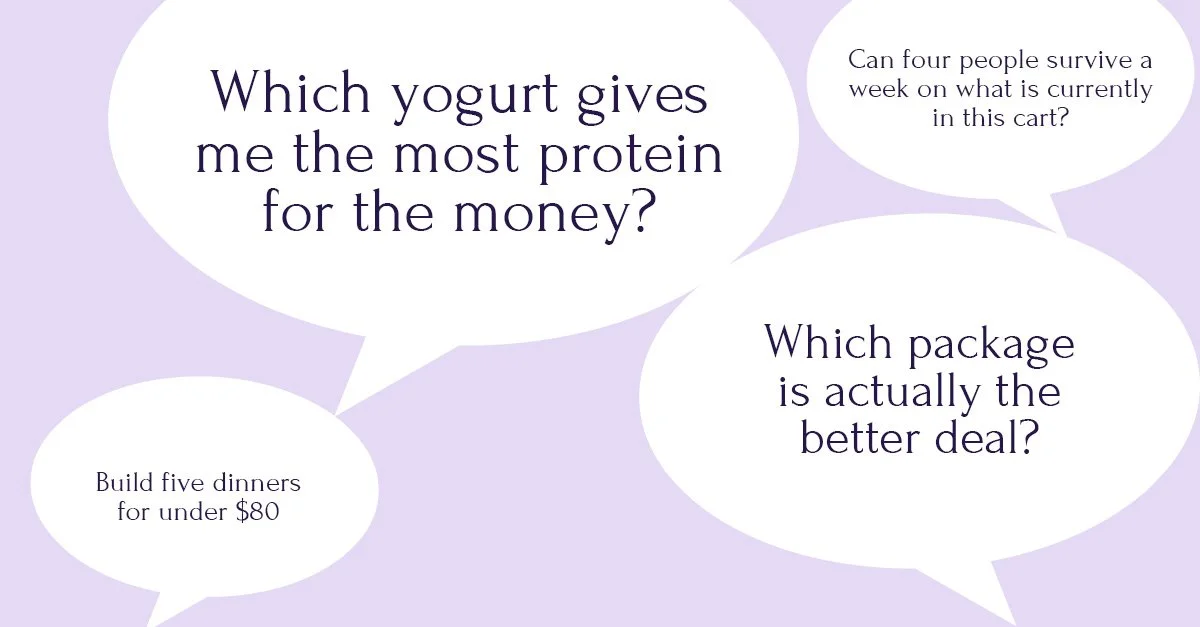
“Build five dinners for under $80.”
“Which yogurt gives me the most protein for the money?”
“Make a meal from these six ingredients.”
“Which package is actually the better deal?”
“Can four people survive a week on what is currently in this cart?”
Okay, maybe don't ask that last one unless you're emotionally prepared for the answer.
The point is that AI doesn't need to complete the transaction to influence it. It simply needs to make one option feel smarter than another.
Make Your Brand Easy to Explain
This creates a surprisingly practical challenge for marketers.
If consumers are increasingly asking machines to compare products, brands need to make their value unusually clear.
Not louder.
Clearer.
A food brand can clearly communicate protein per serving, cost per meal, ingredients, versatility, and nutritional benefits.
A household brand can demonstrate how long a product lasts and what that means in actual cost-per-use.
A grocery brand could create genuinely useful meal-planning content around real-life needs: five dinners under $50, high-protein lunches for a week, or dinner ideas for parents who discovered at 5:42 p.m. that apparently everyone expects to eat again.
The goal isn't to game an algorithm.
It's to make the answer to “Why should I buy this one?” remarkably easy to find.
Machines Can Compare. People Still Care.
There's another side to value that doesn't fit neatly into a comparison chart.
For one household, value might mean feeding an extended family. For another, it means convenience after a ten-hour workday. For another, it's buying the same ingredient their parents used because trust in that brand was established decades before anyone had heard the word “algorithm.”
Value is economic.
But it's also cultural, emotional, and deeply personal.
That's why the rise of AI-assisted shopping shouldn't make brands more robotic.
It should make them more human.
Give the technology clear information to work with. Make your benefits easy to understand. Demonstrate why the product is worth the price.
Then give the person something an algorithm can't manufacture quite so easily: relevance, trust, familiarity, identity, and connection.

At Asheria, that's where we see the real opportunity. We help brands understand the cultural context behind consumer decisions: what different audiences value, what earns their trust, what problems they're trying to solve, and what makes a brand feel like it belongs in their lives.
The consumer journey may be changing. The shortlist may increasingly begin with a conversation instead of a search bar.
And your customer may have a new shopping buddy.
Make sure it has something good to say about you.
Check out how we tap into deep cultural insights to connect brands with new audiences here.