
American Fútbol: The Rise of Soccer Fandom in the U.S.
The 2026 World Cup is here, and for the first time in a long time, America finds itself asking an unusual question:
Do we actually like soccer now?
After all, this is a country where "football" traditionally involves helmets, commercials every six minutes, and enough statistics to make a NASA engineer sweat. Soccer—or fútbol, depending on which side of the family you're talking to—has long occupied a curious space in American culture. Popular? Sure. Present? Absolutely. But central? Not quite.
Yet something is changing.
According to a recent Harris Poll report, 72% of Americans now say they are interested in soccer, while soccer fandom has increased 17% since 2020. Even more telling, 45% of Americans say their interest in the sport is growing.
No, soccer hasn't replaced football.
But it may have stopped asking for permission to sit at the table.
The Long Road to Becoming American
What's happening with soccer isn't entirely unique.
Many of the things we now consider quintessentially American arrived from somewhere else first.
Pizza was once an immigrant food.
Sushi was once considered adventurous.
Yoga was once niche.
Now all three are so embedded in American life that it's difficult to imagine the culture without them.
That's often how cultural adoption works. It doesn't happen through conquest. It happens through familiarity. Through repetition. Through communities sharing pieces of themselves until those pieces become part of the broader story.
Soccer appears to be following a similar path.
The Harris Poll found that while 65% of soccer fans agree that people in America are soccer fans, soccer itself isn't really considered an "American" sport. Yet 48% say soccer is an important part of their culture, and 51% say it is an important part of their lives.
That tension is the story.
The sport doesn't have to become America's pastime to become culturally meaningful.
And increasingly, it is.
The World Cup Effect
Large-scale sporting events have always been powerful engines for fandom.
The Olympics create swimmers.
Formula 1 created an entire generation of American fans through a Netflix series.
And the World Cup has a unique ability to transform casual observers into lifelong supporters.
According to The Harris Poll, 32% of soccer fans say a major competition first sparked their interest in the sport. Meanwhile, 35% of Americans already watch major global soccer events, with that number jumping to 73% among hardcore fans.
The 2026 World Cup will only accelerate that momentum.
Currently, 46% of Americans know the tournament will be hosted in the United States, while 38% say their interest in the competition is specifically driven by the fact that it will be played here. Among existing soccer fans, 70% say they are even more excited because the event will be held in North America. Overall, 87% of U.S. soccer fans say they are interested in the tournament.
That's not just event awareness.
That's a cultural runway.
More Than a Game
Part of soccer's growth comes from participation itself.
Twenty-one percent of fans say youth soccer was their first entry point into the sport. Given that the average American family spends roughly $1,500 per child each year on youth sports, those early experiences matter.
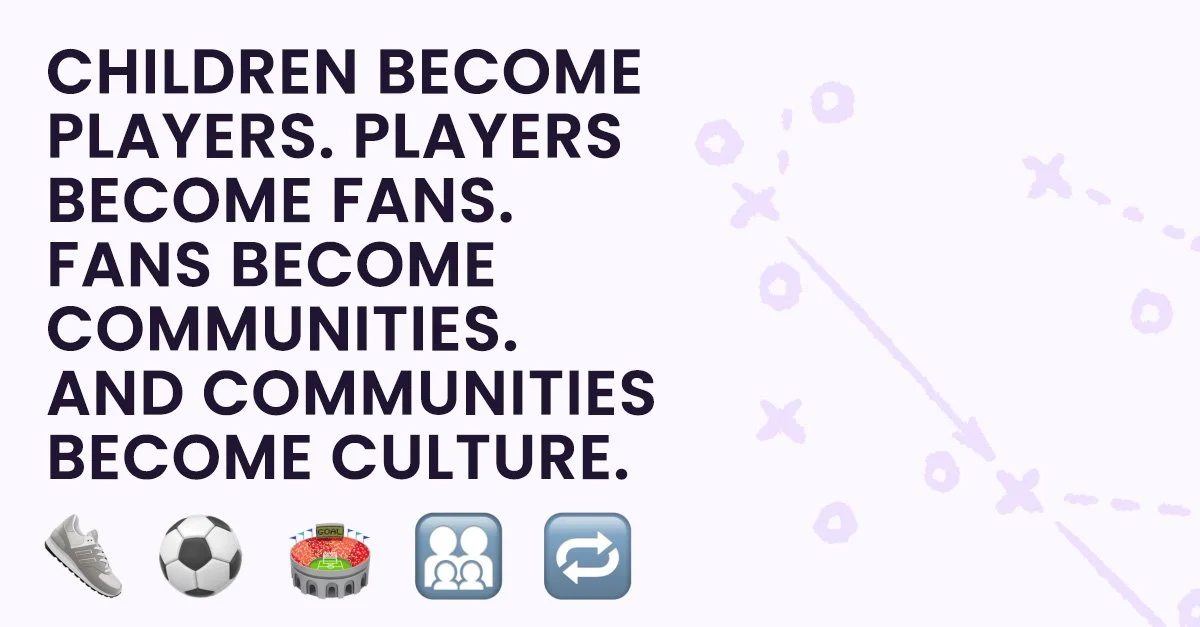
Children become players.
Players become fans.
Fans become communities.
And communities become culture.
What's particularly interesting is how broad those communities have become.
Soccer fandom in America often reflects something larger than sport. It reflects diaspora communities, multicultural identities, global connections, and increasingly, younger Americans who are comfortable navigating multiple cultural influences at once.
In many ways, soccer's rise serves as a reminder that America's greatest cultural strength has always been its ability to absorb, adapt, and remix ideas from around the world.
The melting pot still works.
Sometimes it just wears a jersey.
The Opportunity For Brands To Score
For brands, this moment represents more than a sponsorship opportunity.
It represents a cultural opportunity.
According to The Harris Poll, 54% of soccer fans pay attention to brands that sponsor soccer teams or major events, while 55% say they are more likely to purchase from brands that support their favorite teams or athletes.
Athletes are especially important. Sixty-one percent of fans say individual players bring soccer to life for them, and nearly half follow individual stars as much—or more—than they follow specific teams.
That creates opportunities for brands to build authentic relationships through players, communities, and culture.
But here's the catch.
Marketing to soccer fans isn't the same as marketing to NFL fans.
Soccer fandom is often more global, more multicultural, and more community-driven. It exists across languages, generations, and cultural identities. The brands that succeed won't simply slap a logo next to the World Cup and call it strategy.
They'll understand the people behind the passion.
And they won't ignore women, either.
Women already make up 32% of soccer fans, while 32% of female fans identify as either obsessed or dedicated. Half say they bond with family and friends over key soccer moments. More broadly, 60% of Americans are excited by the growth of women's sports, and 45% say the NWSL is cool to follow or talk about.
The future of soccer fandom isn't just male.
It's increasingly shared.
The Final Whistle
A story about communities becoming visible. About global traditions finding local roots. About younger generations building identities that feel less confined by geography and more connected through shared experiences.
The World Cup will bring millions of eyes to the sport.
But the real opportunity for brands extends far beyond the tournament itself.
At Asheria, we help brands understand the people behind the trends. The communities behind the fandom. The cultural moments that turn attention into belonging.
Because the brands that win in soccer's next chapter won't be the ones shouting the loudest from the sidelines.
They'll be the ones that understand why people showed up in the first place.
Source: The Harris Poll, "America's Surge in Soccer Fandom."
Check out how we tap into deep cultural insights to connect brands with new audiences here.